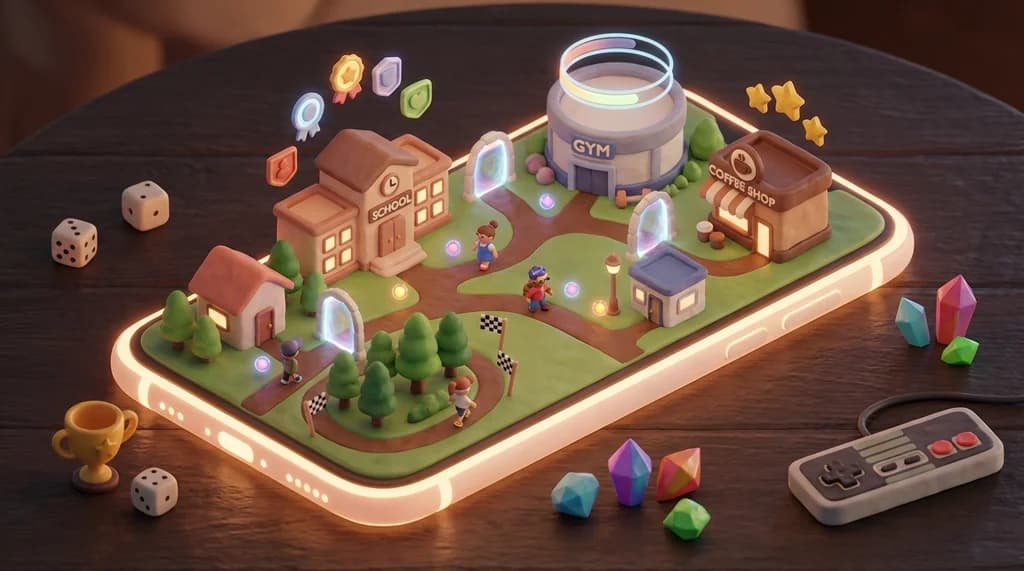
Gamification, Pair of Eyes: How Game Mechanics Shape the Products You Use Every Day
15 min read
Product DesignUXPsychology
“Set your heart upon your work, but never on its reward.”
Bhagavad Gita
You've probably maintained a Duolingo streak, felt a pang of guilt seeing an empty GitHub contribution graph, or caught yourself refreshing your Reddit karma. Maybe you've chased a Fitbit badge or felt oddly compelled to complete your LinkedIn profile to "All-Star" status.
You were being gamified. And you probably didn't mind.
That's the thing about gamification — when it's done well, it doesn't feel like a system acting on you. It feels like you acting on the system. The line between genuine motivation and manufactured engagement is thinner than most people realize, and nearly every product you use daily is standing on it.
This post is a look at gamification through a pair of fresh eyes: what it actually is, why it works on your brain, how the best products implement it, and where the line between helpful design and manipulation sits.
Gamification is the application of game-design elements — points, progress bars, challenges, feedback loops — to non-game contexts. It's not about making things into games. It's about borrowing the psychological machinery that makes games engaging and applying it to learning, fitness, work, or shopping.
The term was coined in 2002 by Nick Pelling, a British programmer consulting on making commercial electronics more engaging. But the concept predates the word by decades. S&H Green Stamps in the 1890s rewarded repeat purchases with collectible stamps redeemable for goods — proto-gamification a century before anyone had a name for it. Airline frequent flyer programs in the 1980s introduced tiered status levels and points accumulation. The mechanics have always been there. We just got better at naming and systematizing them.
A useful distinction: structural gamification applies mechanics like points and leaderboards to existing processes (slapping a progress bar on a course). Content gamification redesigns the content itself around game principles (Duolingo rebuilding language learning as a progression system). The former is cosmetic. The latter is transformative. Most products stop at structural.
Gamification works because it exploits — or, more charitably, aligns with — fundamental patterns in human psychology. Three frameworks explain most of what's happening.
Psychologists Edward Deci and Richard Ryan identified three basic psychological needs that drive intrinsic motivation:
The best gamified products hit all three. Duolingo gives you autonomy (pick your language, set your pace), competence (progressive difficulty, immediate right/wrong feedback), and relatedness (leagues, friend lists, streak sharing). LinkedIn's profile strength bar hits competence at best — and mostly just creates anxiety.
SDT also describes a spectrum from extrinsic motivation (doing something for a reward) to intrinsic motivation (doing it because you genuinely want to). The best gamification uses extrinsic mechanics — points, badges — as scaffolding to build intrinsic motivation. The worst gamification replaces intrinsic motivation with extrinsic rewards, which can actually make the underlying activity less enjoyable over time. Psychologists call this the overjustification effect: start paying someone for something they enjoyed doing freely, and they may stop doing it once the payment stops.
Mihaly Csikszentmihalyi's concept of flow — complete absorption in an activity where time seems to stop — is the gold standard of engagement. Flow happens when the challenge level perfectly matches your skill level. Too easy, and you're bored. Too hard, and you're anxious. The sweet spot is flow.
Games are among the most reliable flow-inducing activities because they naturally incorporate all the conditions: clear goals, immediate feedback, and an escalating skill-challenge balance. Well-designed gamification replicates these conditions. Duolingo's adaptive difficulty, Khan Academy's mastery system, and fitness apps with progressive goals all aim to keep you in that flow channel.
Dopamine — the neurotransmitter behind motivation and reward-seeking behavior — is gamification's neurochemical engine. Contrary to popular belief, dopamine isn't primarily about pleasure. It's about anticipation. It drives you to want, seek, and search. The anticipation of a reward often releases more dopamine than the reward itself.
This is why variable reward schedules — unpredictable timing and magnitude of rewards — are so powerful. Slot machines, loot boxes, and even the pull-to-refresh gesture on social feeds all exploit this. You don't know when or how much reward you'll get, and that uncertainty is precisely what keeps you pulling the lever.
Every notification ping, every "surprise" bonus XP, every mystery reward box is calibrated around this loop.

Gamification has a toolkit. Here's what's in it and what each piece actually does to your behavior.
The "big three" of gamification — and often the only three that lazy implementations use.
Points are the most basic unit. They track progress, provide feedback, and serve as currency. Experience points (XP), karma, skill points, redeemable points — different flavors, same principle. Points work because they make abstract progress concrete. "You're getting better at Spanish" is vague. "+15 XP" is specific.
Badges are visual representations of achievements. They serve as goal-setting devices, social signals, and collection mechanics. A badge for "completed your first open-source contribution" means something. A badge for "logged in 5 times" doesn't. The gap between those two is the gap between meaningful and performative gamification.
Leaderboards rank users against each other. They're motivating for top performers and often demotivating for everyone else. The best implementations segment them — weekly resets (so newcomers have a chance), skill-based tiers (compete with peers, not pros), or friend-only boards (social without the scale anxiety). Duolingo's league system borrows this directly from FarmVille 2, placing users in small competitive cohorts instead of one global ranking.
Consecutive-day engagement tracking. Extraordinarily powerful because of loss aversion — the psychological principle that losses feel roughly twice as painful as equivalent gains feel good. The longer your streak, the more it hurts to break it. Duolingo has built its entire retention strategy around this single mechanic. Each day a user returns, they care more about coming back the next day. It's compounding retention.
Visual completion indicators. They leverage two psychological effects simultaneously: the goal-gradient effect (motivation increases as you approach a goal — the last 10% of a progress bar feels more urgent than the first 10%) and the Zeigarnik effect (incomplete tasks nag at your memory more than completed ones). LinkedIn's profile completeness meter is the textbook example.
A subtle trick: the endowed progress effect. Give users a head start — say, 2 of 10 stamps already filled on a new loyalty card — and completion rates jump significantly. The progress feels more achievable when it's already begun.
Time-bound or themed tasks that create structure and urgency. Daily challenges reset engagement loops. Weekly challenges provide medium-term goals. Seasonal events introduce FOMO and community energy. They work because they transform open-ended activity ("learn Spanish") into discrete, achievable missions ("complete 3 lessons today").
The most underused mechanic. Embedding game elements within a story creates emotional investment that points alone never can. Zombies, Run! wraps exercise in a zombie apocalypse narrative — you're not jogging, you're on a supply run for a besieged township. Suddenly the workout has stakes. Duolingo has been adding character storylines to its lessons, giving you a reason to care about what happens next beyond the XP.

Theory is nice. Let's look at how real products actually use these mechanics — what works, what's clever, and what's quietly manipulative.

Duolingo is the case study everyone cites, and for good reason. It's the most comprehensively gamified consumer app in existence, and the results are staggering: a 4.5x increase in daily active users over four years, 100+ million monthly active users, and the kind of retention numbers most apps would kill for.
The system is layered. Streaks drive daily return visits. XP drives session engagement. Leagues (tiered leaderboards from Bronze to Diamond) tripled the number of highly engaged learners and increased overall learning time by 17%. Hearts limit free-tier mistakes, creating real stakes for each answer. Push notifications are relentlessly optimized — timing, copy, images, localization — generating "dozens of small- and medium-size wins" that compound into massive DAU growth.
What makes Duolingo work isn't any single mechanic. It's that every mechanic reinforces the others, and they all serve the core goal: getting you to practice a language every single day. The gamification is the product.
GitHub's contribution graph — those iconic green squares showing daily commit activity — is one of the most elegant gamification designs in tech. It's technically just a data visualization. But developers feel compelled to "keep the graph green," to maintain an unbroken row of contributions, to show a profile that signals consistent work. It's a streak system that GitHub never explicitly calls a streak system.
Since June 2022, GitHub has also offered achievement badges — Pull Shark (merged PRs), Galaxy Brain (answered discussions), YOLO (merged without review). They're tiered bronze through gold, and they've given developer profiles a collectible dimension.
The contribution graph works because it feels like your record, not a system imposed on you. That's the autonomy principle from SDT in action.
Starbucks attributes approximately 40% of its total revenue to its tier-based loyalty program. That's not a side feature — that's a gamification system generating billions of dollars.
The mechanics: earn Stars per dollar spent (points currency), progress through tiers (Green, Gold, Reserve) unlocking better benefits, complete bonus challenges ("Buy 3 handcrafted drinks this week, earn 50 bonus Stars"), and receive personalized AI-driven offers based on purchase history. Double Star Days create recurring appointment mechanics.
What Starbucks understands that most loyalty programs don't: the tier system creates a status identity. Gold members don't just get better rewards — they feel like Starbucks insiders. That's relatedness and competence working together.
Apple's three activity rings — Move, Exercise, Stand — might be the most successful gamification design in consumer hardware. The visual metaphor is intuitive (close the rings), the goals are personalized and adjustable (autonomy), the streak tracking creates daily accountability, and the social features let you challenge friends.
The rings work because they turn an abstract goal ("be more active") into three specific, visible, closeable targets every single day. And the monthly challenges adapt to your history, keeping you in the flow channel between "too easy" and "impossible."
Reddit's karma system is interesting because it's emergent gamification. Karma was originally just a spam-fighting signal — upvoted content is probably not spam. But users turned it into a reputation game. High karma became a status symbol. Karma gating (minimum karma to post in certain subreddits) created an "earn your way in" progression system. Awards added a gift economy layer.
Reddit didn't design a gamification system. Its community built one on top of a simple voting mechanism.
Here's where things get uncomfortable. The same psychological principles that make gamification effective also make it exploitable. And the line between "helpful engagement design" and "dark pattern" is often a question of whose interests the mechanic serves.
Duolingo's streak is the poster child. Users report completing lessons while sick, on vacation, at funerals — not out of desire to learn, but out of fear of losing a 500-day streak. The streak freeze (purchasable with in-app currency or real money) monetizes this anxiety directly. At what point does "helpful habit formation" become "manufactured psychological distress"?
The question isn't whether streaks work — they demonstrably do. The question is whether a mechanic that causes genuine anxiety when you don't use an app is ethical design.
Time-limited events, seasonal content, expiring rewards. "If you don't play today, you'll miss the exclusive badge forever." This is Octalysis Drive 6 (Scarcity & Impatience) weaponized. BeReal's 2-minute daily posting window is a pure appointment mechanic disguised as authenticity.
Feeds, resetting leaderboards, ever-moving goalposts that eliminate natural stopping points. There's always one more level, one more scroll, one more league to climb. Good gamification includes clear session endpoints ("lesson complete," "daily goal met"). Bad gamification removes them.
The sad Duolingo owl. "These reminders don't seem to be working. We'll stop sending them." It's emotionally manipulative — anthropomorphizing a notification system to make you feel guilty about not using an app. It's effective. It's also a textbook Black Hat mechanic: Drive 8, Loss & Avoidance.
Yu-kai Chou's Octalysis framework draws a useful distinction here. White Hat gamification (epic meaning, accomplishment, creativity) makes users feel empowered and in control. Black Hat gamification (scarcity, unpredictability, loss avoidance) creates urgent, compulsive engagement. Both "work." But White Hat builds lasting positive relationships with users. Black Hat extracts engagement at the cost of user wellbeing.

Regulators are paying attention. Epic Games paid $245 million in settlements over deceptive design patterns. The EU's Digital Services Act and GDPR increasingly address manipulative digital design. Belgium and the Netherlands have classified certain loot box mechanics as gambling. California has proposed legislation targeting addictive design patterns in apps used by children.
The industry is slowly being forced to answer a question it's been avoiding: is your gamification designed to help users, or to exploit them?
If you're wondering whether gamification is a real discipline or a buzzword, the market data settles it:
These aren't marginal improvements. Gamification, when implemented well, fundamentally changes how people engage with products.
After looking at all of this — the psychology, the mechanics, the case studies, the dark patterns — here's where I land.
Gamification is a design amplifier, not a design solution. If your core product experience is broken, no amount of points and badges will fix it. Starbucks Rewards works because Starbucks coffee is already a daily habit for millions. Duolingo works because its core lesson loop is genuinely effective for language acquisition. The gamification amplifies what's already there. It doesn't create engagement from nothing.
The invisible gamification is the best gamification. GitHub's contribution graph doesn't announce itself as a gamification feature. Apple's rings feel like a natural way to track fitness, not a retention mechanic. When you notice the gamification — when you feel the system pulling at you rather than supporting you — the design has failed. Or worse, it's succeeding at something it shouldn't be doing.
Most gamification implementations are shallow. The majority of products stop at PBL — points, badges, leaderboards — and call it done. That's structural gamification at its most superficial. It's "chocolate-covered broccoli," as researcher Sebastian Deterding puts it: a game-like coating on a fundamentally unchanged experience. Real gamification redesigns the experience itself.
The ethics question is not optional. Every gamification mechanic should pass a simple litmus test: does this genuinely help the user achieve their goal, or does it primarily serve our engagement metrics? If the answer is the latter, it's not gamification — it's manipulation with extra steps. The sad Duolingo owl is funny. It's also a guilt mechanic designed to exploit loss aversion. Both things can be true.
Autonomy should be non-negotiable. Users should always be able to opt out of gamified elements. Streaks should have grace periods. Notifications should be controllable. Progress should never feel coerced. The moment your gamification makes someone feel trapped rather than motivated, you've crossed from White Hat to Black Hat territory.
Gamification's future is personalization. The one-size-fits-all approach — everyone gets the same mechanics — is already outdated. Not everyone is competitive (leaderboards alienate cooperators). Not everyone responds to streaks (some people find them stressful, not motivating). The next wave of gamification will adapt to individual motivation profiles, offering different mechanics to different user types. Starbucks is already doing this with AI-driven personalized challenges. Others will follow.
The products that get gamification right — Duolingo, Apple, GitHub, Starbucks — share one thing in common: they treat game mechanics not as features to bolt on, but as design principles to build around. The game isn't separate from the product. The product is the game, and the game serves the user.
That's the pair of eyes worth looking through.

Developers spent decades wishing for tools that write code. Now they have them. Why does freedom feel like loss?

Shadow IT on steroids, MCP tools nobody asked for, LLMs playing architect, vibe-coded open source, and text-to-SQL fantasies. The antipatterns everyone's falling into — and how to stop.
Google leads in math and science. OpenAI leads in agentic coding. Anthropic leads in economically valuable work. A comprehensive breakdown of every flagship AI model with actual numbers.